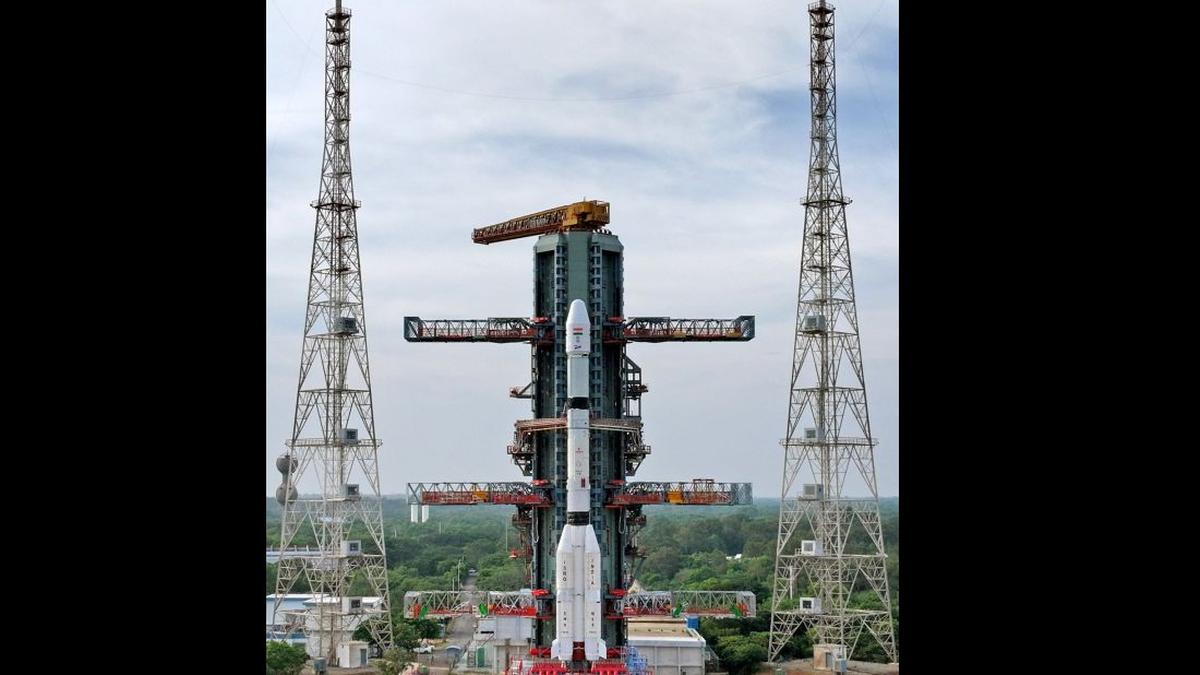
SRIHARIKOTA / NEW DELHI — The countdown for the Indian Space Research Organisation’s (ISRO) high-stakes Geosynchronous Satellite Launch Vehicle mission (GSLV-F18) entered its final phases on Friday at the Satish Dhawan Space Centre (SDSC-SHAR), with mission directors authorising propellent loading for the three-stage rocket ahead of a scheduled late-night lift-off at 11:51 PM IST.
The mission will place the 2,232-kilogram NVS-03 satellite into a Geosynchronous Transfer Orbit (GTO). As the second spacecraft in India’s second-generation Navigation with Indian Constellation (NavIC) series, NVS-03 represents a decisive leap in sovereign positioning, navigation, and timing (PNT) resilience. Most notably, the spacecraft is equipped with a space-qualified indigenous Rubidium atomic clock engineered by the Space Applications Centre (SAC) in Ahmedabad, replacing imported timing standards that experienced operational anomalies in earlier first-generation constellations.
Beyond sovereign security applications, NVS-03 introduces the civilian L1 frequency band (1575.42 MHz), ensuring direct interoperability with consumer smartphones, automotive navigation chipsets, and civil aviation transponders without requiring dedicated dual-band receivers. Senior mission scientists confirmed that the indigenous cryogenic upper stage (CUS-12) will undergo a prolonged 19-minute burn to achieve the precise orbital velocity required for spacecraft separation at an altitude of approximately 36,000 kilometres.
The operational commissioning of NVS-03 will provide uninterrupted positioning coverage over the Indian landmass and an extended maritime zone reaching up to 1,500 kilometres beyond the nation’s international borders. Department of Space officials noted that full civil integration will accelerate compliance with the civil aviation sector’s GAGAN augmentation mandates and smart-transportation telemetry across major urban corridors.
With tracking telemetry stations in Sriharikota, Port Blair, and Brunei networked into the Master Control Facility (MCF) at Hassan, Karnataka, orbital injection updates are expected within forty minutes of ignition.